
(Portions of this essay were originally published in catholicexchange.com/at-pentecost-spread-fire-not-cancer/. Used with permission of publisher.)
Every part of our bodies is ordered towards the good of the whole body. Organ systems do not exist for their own sake but rather to maintain the life and health of the body. The same is true of each individual cell, which does not live for itself but rather for the common good of the body. An essential feature of almost all cells in our body is that they are ready to die for us, a phenomenon known as cell death. Cell death can occur as a response to environmental stress, to protect us from disease, or because the cell is no longer needed by the body. Every second, approximately one million cells give their lives to maintain our health (Douglas Green, Cell Death, Cold Springs Harbor, NY: Cold Springs Harbor Laboratory Press, 2018, p. 1).
What if one cell refuses to work for the good of the body but rather begins to live only for itself? What if it resists giving up its life in cell death and then begins to spread its selfish mode of existence? Such is precisely the origin of cancer. The term “cancer” encompasses a staggeringly diverse group of illnesses, but they all share a common mechanism of origin: “Cancer, we now know, is a disease caused by the uncontrolled growth of a single cell…. In a normal cell, powerful genetic circuits regulate cell division and cell death. In a cancer cell, these circuits have been broken [through genetic mutations], unleashing a cell that cannot stop growing” (Siddartha Mukherjee, The Emperor of All Maladies: A Biography of Cancer, New York: Scribner, 2010, pp. 458-459).
Given the rate of normal cell division and the probability of harmful mutations arising, we should all be “riddled” with cancers all of the time (Green, p. 195). Thankfully, our bodies have many different ways of preventing cancers and of destroying new cancers before they cause problems. But if one cancer cell is not recognized and destroyed in time by the body, it can multiply and spread with astonishing success, coopting the body’s systems for its own deranged purposes.
God is self-giving love. From all eternity, the Father, the Son, and the Holy Spirit pour themselves out one for the other in an eternal community of love. We were created in God’s image and invited to join this community of life-giving love. When Adam and Eve sinned, they clung to the cells of their little selves and refused to give them up in love and obedience to God. They allowed pride to take the place of self-giving love, echoing the “Non serviam!” of the satanic revolt against God. Original sin could be described as a harmful “mutation” in humanity’s spiritual “DNA” that we have all inherited.
The original sin of pride multiplies into all the other kinds of sin, just as the original cell of cancer multiplies and spreads. Sin harms all those we are connected to—our “body”—and ultimately kills us spiritually, just as a “successful” cancer ultimately kills itself by killing the body where it grows. (Of course, those of us with biological cancer are no more sinful that the rest of us.)
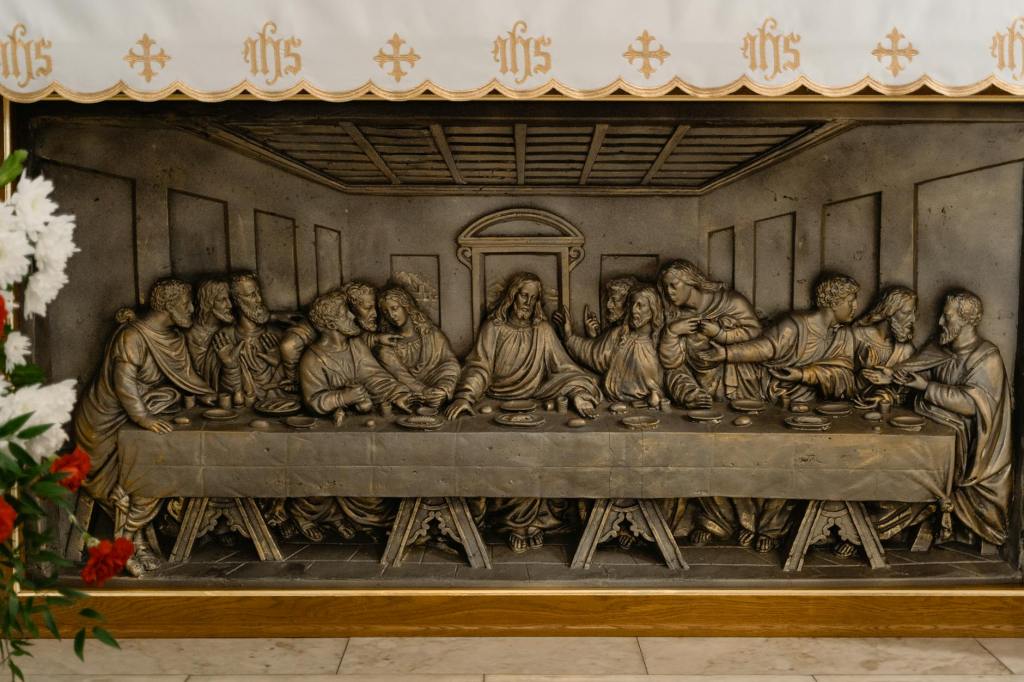
Jesus opened up for us the possibility of returning to spiritual health by embracing the way of the healthy cell. He “humbled himself and became obedient unto death” (Philippians 2:7-8), the cell death of His Crucifixion. In the most common method of cell death, apoptosis, cells deliberately package themselves to be eaten by other cells (Green, p. xvii)—a microscopic reflection of the Eucharist. But Jesus’s cell death leads beyond the grave to a new and indestructible life: “we have been born anew to a living hope through the resurrection of Jesus Christ from the dead, and to an inheritance which is imperishable, undefiled, and unfading” (1 Peter 1:3-4). When we submit our spiritually cancerous selves to God through Baptism and the other sacraments, the cancer is excised, and our “spiritual DNA” is put right once more, enabling us to live as healthy cells in the Body of Christ.
Once we are incorporated into this healthy life in Christ, we must actively choose to stay in it. We must engage in the “conflict between two loves: the love of God to the point of disregarding self, and the love of self to the point of disregarding God” (Pope Saint John Paul II, Familiaris Consortio, paragraph 6). The struggle between the live-giving love of God and the prideful love of self continues as long as this life lasts. As our bodies are constantly on the lookout to prevent and destroy new biological cancers, we must regularly examine our consciences and go to sacramental confession to keep cancerous pride from taking over.
As cells in the Body of Christ, we must live for the good of others: our families, our communities, our parishes, the Church, and the Kingdom of God. This kind of life involves sacrifice and pain; we must daily embrace the Way of the Cross, or the Way of Cell Death. But Jesus tells us that this is the only way that leads to life: “whoever would save his life will lose it, and whoever loses his life for my sake will find it” (Matthew 16:25).


 Summa Vanessae
Leave a comment