
All living things, ourselves included, begin life as a single cell. Bacteria and many protists continue as single-celled organisms for their entire lives, but in fungi, plants, and animals, that single cell divides many times, increasing in number and specializing in function, until it has grown and developed into a mature organism comprised of trillions of cells. In humans, that single cell was originally an egg in the fallopian tubes of the mother fertilized by sperm from the father that implanted in the uterus of the mother and grew to maturity.
Jesus Christ also began His earthly life as a single cell. When the angel Gabriel came to Mary to announce that she had been chosen by God to be His mother (Luke 1:26-38), she was probably ovulating. When Mary gave her “yes” to God’s invitation, the Holy Spirit came upon her as the fertilizing agent, and Jesus was conceived. The single cell of the Incarnation began to divide, passing through all the stages of embryonic and fetal development, until the infant Jesus was born.
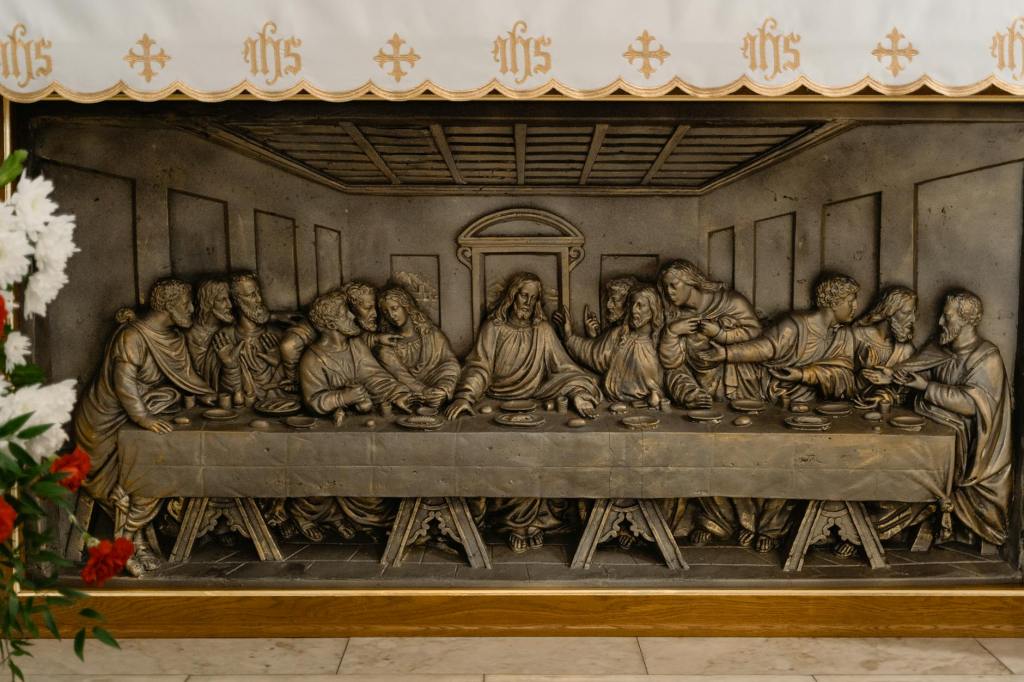
Before He ascended into heaven, Jesus told His apostles “not to depart from Jerusalem, but to wait for the promise of the Father,” that is, the Holy Spirit (Acts 1:4). Accordingly, they waited in the Upper Room (the location of the Last Supper), like a tiny egg waiting in the fallopian tubes, a comparison strengthened by the presence of Mother Mary (Acts 1:14). As the Holy Spirit descended on the bread and wine in the upper room on Holy Thursday to transform them into the Body and Blood of Christ, the Holy Spirit descended on the Upper Room on Pentecost as the fertilizing agent to transform the disciples into the Body of Christ, the Church (Acts 2:1-4). The fertilized egg of the Church traveled out of the fallopian tube of the Upper Room and implanted in the womb of Jerusalem, where it immediately began to grow and multiply, specialize and diversify, taking in “Jews” and “devout men from every nation under heaven” (Acts 2:5), until “there were added that day about three thousand souls” (Acts 2:41). The words from Psalm 87:5 came to fulfillment that, of Jerusalem, it would be said that people from all nations “were born in her.”
In several of his letters to the earliest Christian communities, Saint Paul calls the Church the Body of Christ: “For just as the body is one and has many members, and all the members of the body, though many, are one body, so it is with Christ. For by one Spirit we were all baptized into one body—Jews or Greeks, slaves or free” (1 Corinthians 12:12-13). This image highlights the unity and connectedness of all Christians with their diverse callings as well as the growth continually experienced within the fertilized egg of the Church:
“[Christ’s] gifts were that some should be apostles, some prophets, some evangelists, some pastors and teachers, to equip the saints for the work of ministry, for building up the body of Christ…we are to grow up in every way into him who is the head, into Christ, from whom the whole body, joined and knit together by every joint with which it is supplied, when each part is working properly, makes bodily growth and upbuilds itself in love.” (Ephesians 4:11-12, 15-16)
Paul highlights that love is the animating and organizing principle of the Church. Love is what makes it possible for the countless “cells” of individual believers to retain their identity and yet be united into the one organism of the Body of Christ. The diabolical voice in C.S. Lewis’s The Screwtape Letters helps us appreciate the significance of this arrangement:
“The whole philosophy of Hell rests on the recognition of the axiom that one thing is not another thing, and, specially, that one self is not another self. My good is my good, and your good is yours. What one gains another loses. Even an inanimate object is what it is by excluding all other objects from the space it occupies; if it expands, it does so by thrusting other objects aside or by absorbing them. A self does the same. With beasts the absorption takes the form of eating; for us, it means the sucking of will and freedom out of a weaker self into a stronger. ‘To be’ means ‘to be in competition.’
“Now, the Enemy’s [God’s] philosophy is nothing more nor less than one continued attempt to evade this very obvious truth. He aims at a contradiction. Things are to be many, yet somehow also one. The good of one self is to be the good of another. This impossibility He calls Love, and this same monotonous panacea can be detected under all He does and even all He is—or claims to be. Thus He is not content, even Himself, to be a sheer arithmetical unity; He claims to be three as well as one, in order that this nonsense about Love may find a foothold in His own nature. At the other end of the scale, He introduces into matter that obscene invention the organism, in which the parts are perverted from their natural destiny of competition and made to cooperate.” (New York: Macmillan, 1982; pp. 81-82)
Rather than competing, the cells of the Body of Christ cooperate for the good of all, a sign of the guiding love of the Holy Spirit. As Pope Francis taught in a homily entitled “Abiding in Christ,” “Only the Spirit can awaken diversity, plurality, and multiplicity, while at the same time building unity.”[1]
The development of the organism of the Church extends far beyond Pentecost and Jerusalem to include all Christians of all times. Our incorporation is accomplished through the sacraments of initiation: “The sharing of the divine nature given to men through the grace of Christ bears a certain likeness to the origin, development, and nourishing of natural life. The faithful are born anew by Baptism, strengthened by the sacrament of Confirmation, and receive in the Eucharist the food of eternal life” (Catechism of the Catholic Church 1212). The Church, the Body of Christ, which now reaches across the entire Earth and throughout 2,000 years, began as something tiny, like the single cell of a fertilized egg.


 Summa Vanessae
Leave a comment